How AR and VR improve education
Immersive learning is strongest when it helps students see, manipulate or rehearse something that is hard, expensive or impossible to bring into the room.
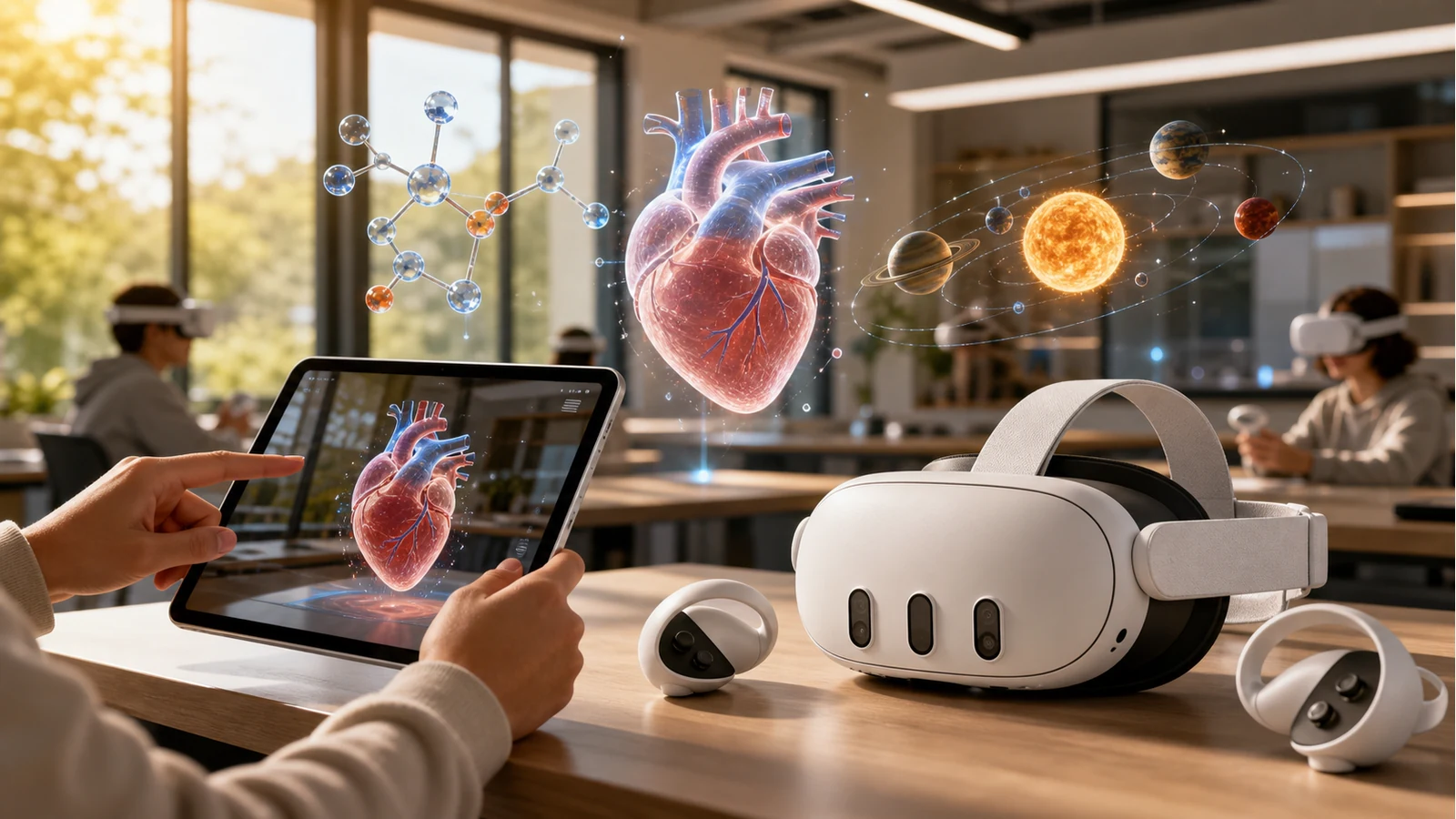
AR and VR turn lessons into places students can inspect. AR keeps the real classroom visible and adds models or interactions on top of it. VR places the learner inside a simulated environment where scale, depth and motion become part of the explanation.
Make invisible systems visible
Biology, physics, chemistry and engineering depend on systems students cannot easily see. XR can expose a molecule, a magnetic field, a cell, a machine part or a planetary orbit at a scale the learner can walk around and understand.
Let students practice safely
Some practice is expensive, risky or hard to repeat: lab procedures, emergency response, equipment handling and public speaking. VR lets students rehearse the situation before the real version; AR can guide them through steps while they work with physical tools.
Increase attention without turning learning into a gimmick
Immersion works when it serves the objective. A short XR activity can make the key concept memorable, then hand the student back to discussion, writing or assessment with a clearer mental model.
Where XR fits best in education
The strongest fits are science, technical training, history and culture, design, architecture, healthcare simulation and any subject where scale, place or procedure matters.
How XR Designer helps
XR Designer lets educators and studios create AR and VR experiences visually: build the 3D scene, add interactions, generate AI textures or models, and publish a link.
Build your next XR experience
Compose AR or VR in the browser, publish to a link and test the idea without starting from code.
Start building free